Monday, November 24, 2008

Solid Energy hot on coal

By KRIS HALL - The Dominion Post | Tuesday, 25 November 2008

A successful Waikato coal-seam gas project which supplies enough energy for more than 500 homes showed how New Zealand is "now the lucky country" for its energy resources, Solid Energy chief executive Don Elder says.

Speaking at the state-owned company's maiden annual meeting in Auckland yesterday, Dr Elder dodged the sniping remarks of protesting environmentalists by talking up New Zealand as perfectly placed to exploit growing demand for coal.

The coal-seam gas scheme was the first of its type in New Zealand.

The scheme was adding up to one megawatt of electricity to the national grid. "Our resources in the Waikato are potentially as big as Kupe gas field and could provide up to 10 per cent of New Zealand's gas supply," Dr Elder said.

Gas from Solid Energy's four Huntly wells contain only 1 per cent carbon dioxide and 98 per cent energy-rich methane. The gas has a lower carbon footprint than conventionally produced natural gas, which up till now was New Zealand's cleanest thermal power source, Dr Elder said. Read more...


Beshear Calls for Nuclear and Clean Power: Promoting Coal-to-Liquid Technology and Lifting Bans Will Keep Jobs in, and Bring New Ones to, the Region

Friday, November 21, 2008 5:54 AM

(Source: The Paducah Sun)trackingBy Bill Bartleman, The Paducah Sun, Ky.

Nov. 21--Western Kentucky would benefit from a comprehensive energy policy that includes consideration of nuclear power plants, nuclear recycling facilities and coal-to-liquid fuel plants, Gov. Steve Beshear said Thursday.

Beshear released a 144-page plan that he hopes to begin implementing next year when the General Assembly meets. It will take several years to carry out some parts of the plan because of the potential cost, Beshear said in a phone interview.

He said the plan would help make Kentucky a leader in the national effort to reduce energy dependence on foreign countries, many of which are enemies of the United States.

"It also has an economic development benefit," Beshear said. "If we are successful in carrying it out, 40,000 new jobs would be created by 2025."

He said one of the early goals would be to lift the state's 1979 ban on building new nuclear power plants.

"It is time to have conversations about the role that nuclear power should play in the future," Beshear said. "It already is part of our strategy nationally because we produce 20 percent of our electricity by nuclear energy."Read more...


Wednesday, November 19, 2008

Some Mat-Su homeowners turn to coal for heat

ANCHORAGE, Alaska — The high cost of heating oil prices has some homeowners in the Matanuska-Susitna Borough turning to coal. Houston homeowner Roger Purcell used his family's state energy rebate money to buy a coal stove after a fill-up of his heating oil tanks took a big bite out of his bank account. "We're hoping to cut our fuel cost this year in half of what we had last year," Purcell said. "For the price and the reduction of fuel, it made it very cost efficient - just in the first month in a half, the furnace will pay for itself." Read more...

Tuesday, November 18, 2008

Beacon Redevelopment Industrial Corporation Completes Purchase and Development Agreements of its Coal Mining Rights and Receives Valuation Estimates

November 18, 2008

Beacon Redevelopment Industrial Corporation (Pink Sheets: BCND) today announced that it's wholly owned subsidiary Beacon Energy Corporation has finalized and completed the purchase of 100% of the coal rights for two parcels of land totaling 1020 acres in Westmoreland County, Pennsylvania. The coal forms part of the Upper and Thick Freeport Coal Seams in Western Pennsylvania.Beacon Energy Corporation will contract with a qualified mining company that will utilize modern equipment and technologies, thus allowing Beacon Energy to secure the maximum amount of coal output using longwall methods of extraction. Beacon's consultants estimate that these rights will provide the company access up to 2.5 million tons of coal production during the extraction period. Read more...

Canasia Industries Corporation: Awarded Coal Permits From Saskatchewan Government

VANCOUVER, BRITISH COLUMBIA, Nov 18, 2008 (MARKET WIRE via COMTEX) -- Canasia Industries Corporation ("Canasia")has received approval from the Saskatchewan Ministry of Energy and Resources for nine coal permits covering 4,000 hectares (approximately 9,884 acres). These permits are in close proximity to a recent coal discovery made by Goldsource Mines Inc. Canasia has received partial applications to date from the Saskatchewan Government and management anticipates receiving additional permits in the near future. Once a response has been received on all applications, the board will establish a work plan for the coal permits that have been accepted. Read more...

Friday, November 14, 2008

Coal to remain world's top power source: IEA

November 14, 2008

LONDON (Reuters) - Coal, which produces more climate-warming carbon dioxide than oil or gas, will remain the world's main source of power until 2030 and nuclear will lose market share, the International Energy Agency said on Wednesday.

Expectations of slower economic growth have led the IEA to downgrade its 2030 world electricity demand forecast to 23,141 terawatt hours (TWh), but the share of coal generated power would rise to 44 percent by 2015 from 41 percent in 2006.

It would stay at that level to 2030.

"Globally, coal-based electricity is projected to rise ... to almost 14,600 TWh by 2030, giving rise to significant increases in associated CO2 emissions," the Paris-based agency said in its World Energy Outlook. Continue...


'Clean coal' technology to cut emissions

November 14, 2008

The Queensland and federal governments are hoping a world-first combustion technology project will revolutionise coal-fired power.

The technology, being trialled at the Callide A power station in central Queensland, is aimed at cutting carbon dioxide emissions by 90 per cent compared with conventional coal-burning systems.

Federal Resources Minister Martin Ferguson and Queensland Energy Minister Geoff Wilson attended a ceremony on Friday to mark the start of construction work at the $206 million Callide Oxyfuel Project.

"This is the first project of its type anywhere in the world and governments and industry across the globe are keenly awaiting its results," Mr Ferguson said.

"It's projects like this which will guarantee a future for coal in Australia." Continue...


Thursday, November 13, 2008

UK Coal to build wind farms on old collieries

November 13 2008

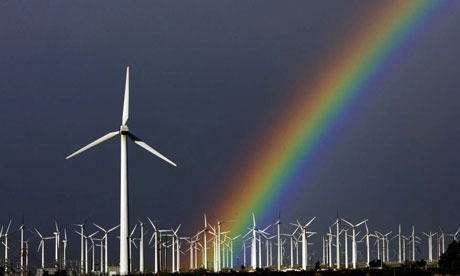
Windfarm and rainbow

UK Coal aims to construct 54 wind turbines on sites once used for coal mining. Photograph: Sandy Huffaker/AP

Over a dozen of the UK's former coalmining sites are to be redeveloped as wind farms under a revolutionary energy scheme to turn old energy into new.

UK Coal, once the main part of the National Coal Board, has unveiled a joint venture with Peel Energy that would see 14 old colliery locations used to erect 54 turbines generating around 133MW of electric power.

Shares in UK Coal raced forward 10% in early trading as the City welcomed the initiative.

"We believe there is significant opportunity to develop wind farms on parts of our land portfolio. By allying with Peel Energy, we are joining forces with one of the UK's most active and knowledgeable wind power companies," said John Lloyd, the chief executive of UK Coal. Continue...

Plant in Fairbanks looks to turn coal into liquid fuel

November 12, 2008

FAIRBANKS, Alaska-- A new study out of Fairbanks holds high hopes for a local plant that could turn coal and biomass into liquid fuel.

The study is commissioned by the Fairbanks Economic Development Corporation.

The corporation says coal-to-liquids technology can work in a northern environment and that it would be financially viable based on $120 a barrel crude oil.

The study says a coal-to-liquids plant would cost between $4 billion to $7.5 billion.

Wednesday, November 12, 2008

Black River Invests Significant Sum to Joint Venture With White Energy in Africa

November 10, 2008

SYDNEY, Australia, Nov 10, 2008 /PRNewswire-FirstCall via COMTEX/ -- White Energy Company Limited (White Energy (ASX: WEC)) is pleased to announce that it has signed a joint venture agreement with an entity managed by Black River Asset Management LLC (Black River), an independently managed subsidiary of Cargill, under which White Energy and Black River will jointly develop and commercialise White Energy's coal upgrading technology throughout Africa.
White Energy and Black River will establish a special purpose company (the Company) to be held 51% by White Energy and 49% by Black River. The Company will actively originate, develop, construct and operate coal upgrading plants in Africa either on its own or in conjunction with companies in Africa having access to appropriate coal reserves and/ or power companies looking to increase their energy output. The Company will have the exclusive rights to utilise White Energy's coal upgrading technology on the African continent. Continue...

Monday, November 10, 2008

68,000MW projects face a blackout

November 10, 2008

The power ministry had earlier asked the coal ministry for coal to generate 125,000MW, which includes 68,000MW for so-called independent power producers, or IPPs. It later scaled down its demand to 35,000MW, with half this amount designated for IPPs. The coal ministry had agreed to supply coal for only 10,000MW.

Ways of coping: A coal mine in Andhra Pradesh. India will not meet its projected demand of 730mt by 2012, unless 100mt of coal is imported. Noah Seelami / AFP

Ways of coping: A coal mine in Andhra Pradesh. India will not meet its projected demand of 730mt by 2012, unless 100mt of coal is imported. Noah Seelami / AFPImported coal typically has a higher calorific value, which reduces wastage and also improves the efficiency of power plants. Analysts estimate that one tonne of imported coal is equivalent to 1.56 tonnes of domestic coal.

To generate 1MW of power, around 5,000 tonnes of coal per annum is required. India has 256 billion tonnes of coal reserves, of which around 455mt is mined every year. The country currently imports around 40mt of coal.
Domestic coal demand is expected to touch around 2 billion tonnes a year by 2031-32, about five times the current rate of extraction, with the maximum demand coming from the power sector.
However, power project developers are not happy with the arrangement. “Even if the imported coal is priced at around $70 (about Rs3,346) per tonne at the entry ports, with inland transportation, it will come to around $94 per tonne. This, in turn, will increase the electricity tariff by around 10-15% depending upon the amount of imported coal used,” said a Hyderabad-based IPP developer on condition of anonymity. Domestic coal is available for Rs1,000 a tonne (including transportation costs).
While the coal ministry has expressed its inability to meet the demand due to the long gestation time required for the development of new mines, the power ministry is of the view that there is a shortage of 14mt even for the operating stations due to low production by CIL, the country’s largest mining company.
CIL has a coal output of 380 million tonnes per annum, or mtpa, and plans to increase it to 405mtpa by 2009-10.

H.C. Gupta, coal secretary, said, “We need to maximize domestic production and any gap has to be met through imports. The coking coal (used by the power sector) production in the country has not grown as per the demand. As per the 11Plan (2007-12) projections, we expect the imported coking coal demand for the power sector to go up to 40 mtpa by 2012.”
The government would not be able to meet the projected demand for about 730mt of coal by 2012, unless 100mt of the fuel is imported.

According to India’s economic survey for 2007-08, growth in coal production has dropped from a high of 6.2% between April and December 2006 to 4.9% in the same period in 2007.
On 9 September, Mint had reported that power projects capable of generating a combined 68,000MW were being put at risk because of the government’s failure to assure coal supplies.
“Inevitability of coal imports may not be synonymous to CIL being the facilitator since such canalizations may mean additional cost to the consumer in terms of CIL’s administration charges. However, such options of imports that exist for most power producers may be well exercised by developing bargaining power in the international markets through demand consolidation, which CIL can assist with. There is a need to look at import markets with a long-term view, rather than resorting to ad hoc spot purchases, which may be expensive and uncertain,” said Dipesh Dipu, principal consultant (mining) with audit and consulting firm PricewaterhouseCoopers.

Coal, power ministries agree on imports

November 10, 2008

Coal India Ltd has a coal output of 380 million tonnes per annum, or mtpa, and plans to increase it to 405mtpa by 2009-10

New Delhi: India’s coal and power ministries, which had locked horns over the supply of coal to new power projects, have reached a compromise by which 10-15% of the coal requirement for such projects will be made through imports by state-owned Coal India Ltd, or CIL, although this will increase the cost of the power generated by these plants.
The decision was taken at a recent meeting held between the ministries of coal and power, according to a government official who didn’t want to be named. The meeting was also attended by representatives of NTPC Ltd, CIL and Central Electricity Authority. The proposal to import coal was made by the power ministry, and the coal ministry agreed to it on the condition that the former facilitates the fuel supply agreement between the power utilities and CIL.

UPDATE 2-Orica sees coal demand underpinning '09 growth

November 10, 2008

MELBOURNE, Nov 10 (Reuters) - Australia's Orica Ltd (ORI.AX: Quote, Profile, Research, Stock Buzz), the world's top maker of explosives used in mines, expects profit to grow in 2009, bolstered by steady demand from coal miners, defying cutbacks in other mining sectors.

The positive outlook and a stronger-than-expected second-half result helped push the group's shares up more than 6 percent, while the broader market added 2 percent.

"They were a little more upbeat about mining than I would have thought," said Ken West, a partner at fund manager Perennial Growth. "It's quite good to have a company that's still got some growth," he added, contrasting Orica with other companies that were likely to report falling profits this year.

Orica's managing director, Graeme Liebelt, said demand from countries like China, where he expects annual economic growth of around 8 percent, would underpin demand for coal used in power stations. The bulk of Orica's explosives go to coal miners.

"We see relatively robust demand coming through. We would not expect much, if any, scaleback in that sector," Liebelt told reporters.

Second-half profit before one-offs rose 16 percent to A$342.5 million, topping analysts' forecasts for around A$306 million, according to Reuters calculations.

Earnings from the Minova business, which it acquired last year and makes explosion trigger systems, grew more than analysts had expected. Continued...

Friday, November 7, 2008

Future Fuels, IMC invest in clean coal project

November 7, 2008

Future Fuels LLC and Immersive Media Corp. have formed a joint venture to develop a clean coal project.

Future Power PA LLC, a wholly owned subsidiary of Houston-based Future Fuels, will lead the project, which involves developing an electricity generation project using clean coal gasification technology in Schuylkill County near Allentown, Penn.

IMC, a digital video imaging company based in Calgary, Canada, will put up $5 million to start the project.

The joint venture will work to permit a small electricity generation facility that will utilize integrated gasification combined cycle clean coal technology. The technology will allow for low transmission costs for electricity, according to Future Fuels.

Clean coal technology sounds great but still to be proven, says Globe-Net

November 7, 2008

There was a lot of talk about 'Clean coal technology' during the election campaign in the United States. Both the Democratic and Republican nominees wanted to place it at the forefront of their energy independence strategy. John McCain pledged to speed up its development with a $2 billion a year investment until 2024. Barack Obama wanted to build 'five ’first-of-a-kind’ commercial scale coal-fired plants with carbon capture and sequestration.'

Essentially, McCain and Obama want power station smokestacks to grab the carbon dioxide (CO2) they emit when they burn coal. The CO2 would be transported to a storage site via pipelines, ships, rail or trucks. There it would be injected into rock formations deep below the Earth’s surface. Since the U.S. is the world’s second largest emitter of CO2 emissions after China, the technology would reduce air pollution substantially. Read full story here

Thursday, November 6, 2008

Facts


  • Coal accounts for half of the electricity use in the U.S.
  • Coal costs less than any other major fossil fuel source.
  • The world’s largest producers and consumers of coal are China, Poland, Russia, India and the United States.
  • Total world consumption of marketed energy is projected to increase by 57 percent from 2004 to 2030.
  • Coal’s share of total world energy use climbed from 25 percent in 2003 to 26 percent in 2004 and is expected to increase to 28 percent by 2030.
More facts? Click here

New Poll Data Reveals 70 Percent Public Opinion Approval for Coal-Fueled Electricity

Nov. 6, 2008

DENVER, Nov 06, 2008 (BUSINESS WIRE) -- With energy demand a top issue for the incoming administration, new poll data released shows overwhelming support and optimism for the use of coal to produce electricity in the United States.
The results are based upon a recent national public opinion survey sponsored by the American Coalition for Clean Coal Electricity (ACCCE) and fielded in mid-October:
-- 72 percent of opinion leaders nationwide support the use of coal to generate electricity, a significant increase over the past year and the highest level of support since the group began polling nearly 10 years ago.
-- When asked the question "do you believe coal is a fuel for America's future?"- 69 percent of Americans agreed (compared to 26 percent who disagreed).
-- 72 percent agreed that new technologies would allow coal-based electricity plants to meet an ultra-low emissions profile (near zero emissions including the capture and storage of carbon dioxide) within the next 10 to 20 years.
-- 84 percent agreed developing new advanced clean coal technologies offered opportunities to create American jobs and export these technologies to other countries (65 percent).
"The fundamentals of the energy debate have changed," said Joe Lucas, vice president of communications, ACCCE. "While environmental concerns were the primary driver of the debate in the past, this poll shows that energy security concerns are more pressing for the key voters. This means that policymakers will be looking to solutions that will ensure domestic energy resources such as coal play an expanded role in meeting future energy needs."
The poll was conducted October 7-9, 2008 by AmericanPublic.us and RT Strategies. The poll interviewed 600 opinion elites nationwide. Elites are defined as adults with $80,000 or more in household income and a four-year college degree or more and a professional or managerial job title or a business owner and a high degree of involvement in politics and policy matters.

Wednesday, November 5, 2008

ADA-ES Inc to develop clean coal technology for DOE

November 05, 2008

ADA-ES Inc (NASDAQ:ADES), a company which develops and commercialises solutions for reducing emissions and meeting environmental standards, said on 4 October that it has signed a project contract with the US Department of Energy (DOE) to develop clean coal technology that will capture carbon dioxide from coal-fired power plants.
The company has been hired as a prime contractor for a USD3.2m project with the DOE's National Energy Technology Laboratory. The programme is co-funded by power generators including AEP, Southern Company, Luminant, Xcel Energy and the Electric Power Research Institute. A Technology provided by ADA-ES will reduce the emissions of greenhouse gases from existing coal-fired boilers. The existing 1,100 power plants generate 320 GWs of electricity and represent the single largest US man-made source of carbon dioxide. A The project will advance carbon capture technology based around regenerable solid sorbents and equipment. Solid sorbents offer potential advantages over competing technologies including lower costs and less parasitic energy.